In
Bolivia, a “palliri” is a woman who picks up the minerals taken out from
a mine, while the “Tío” is the guardian devil of a mine.
The
story tells that a Tío fell in love with the most beautiful palliri in his
mining village. Her name was Soledad Chungara; she had long braids and her
skin was whiter than china. Though she sometimes looked like a nun, with the
white veil on her head and the long black skirt, she was considered a woman
of hill repute. The miners did not dare to look at her in the eyes, as they
thought that her curse was hidden behind hear beauty.
Actually,
nobody knew where she came from. She had neither children nor husband, but
she worked as
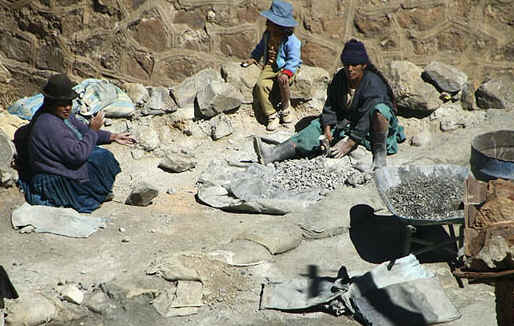
Palliris
at work
a
palliri in mines, grinding with her hammer and picking up pieces of
mineralized rock accumulated as a reserve by the company just out of the
village. Later, she moved to work inside the mine, where the Tío, as soon
as he saw her at the light of the lamps turning on and off within the
gallery, remained enchanted by that palliri who was dressed like all miners
but had a big bust, wide flanks and the hair arranged in braids.
The
Tío got up from his throne and, observing the size of her buttocks, which
could be those of a mule if they were not part of a woman body, he talked to
her in a language known only by the older miners. The palliri neither said
anything nor was frightened by the presence of the Tío, whose devilish
image was the most awful she ever had seen. The Tío sat down again on the
throne and the palliri sat down on the beam, waiting for the others leaving
the gallery. When the palliri remained alone with the Tío, she offered him
a handful of coca leaves and a sip of brandy. She put the k'uyuna (small
Bolivian cigarette) in his mouth and lighted the tobacco illuminating the
faces of both of them. Then they looked at themselves from close up, very
close up, as if they were the Beauty and the Beast. The Tío fondled her
breast with a long-clawed hand, like that of a devil, and the palliri just
crossed her legs.
They
did not speak until he broke the silence and said:
“You
are the first woman entering the mine disguised as a man.”
They
kept quiet, lighted up the Tío with the lamp embedded in the helmet and
replied:
“I
am here because I want make money before returning to my village.”
The
Tío laughed loudly, looked at her opening wide his eyes large as beacons
and offered her the best tin vein. In exchange for that, he would become her
master. The palliri accepted provided that he would show previously the
vein. The Tío kept his word. He took her by the hand, brought her at the
end of a far gallery and showed her the vein. The palliri gazed astonished
at the tin, which shined like the head of an enormous nail hammered in the
rock. She thanked God and the Pachamama (Mother Earth), but she thought to
make fun of the Tío; they first would accumulate the money and then she
would leave the village by the same way she had come.
The
Tío waited for her sitting on the throne, neither calling nor watching over
her. She exploited the vein, marketed the tin and became the prosperous
woman in the region. In a few time she became the owner and master of the
village, obtaining the respect of those who previously looked at her
contemptuously. However, people who were aware that her richness was the
fruit of a deal with the Tío treated her suspiciously and in a detached
way. What should she do with so much money, if she had sold her soul to the
devil? The oldest miners argued that the palliri would never be happy,
unless she offered herself to the Tío as a servant, since the happiness of
a woman does not lie in riches but in modesty and in her body’s dignity.
So,
being victim of her surly ambition and tricks, the palliri found herself
wrapped in a cloud of disillusion and desperation. She knew neither what to
do with the money nor how to comply with the agreement with the Tío. This
story was tormenting her and her life had turned into a nightmare. She never
went back into the mine and remained closed in her room, from where she
never went out unless to eat and drink.
The
worst thing was that the Tío, whose terrifying image was impressed in her
retina, persecuted her even in her dreams: it happened to her to see herself
nude against the rock of an abandoned vein where the Tío whipped her until
she bled, while she begged his forgiveness promising to keep the promise to
give him her life. At other times, she felt as the Tío dwelled in her,
since she dreamed of him on the day and felt him within herself at night.
About to copulate, the Tío, who had big horns, claws and long teeth,
penetrated her with the fire of his body and the vapor of his breath. She
cried and shouted in her sleep while twisting in the bed like a snake. When
waking up dripped with sweat and tears, she felt that the Tío had
penetrated her through the moist cavity opening between her legs.
Eventually,
tired to bear those terrifying nightmares, the palliri stopped sleeping and
kept awake assuming coca and alcohol, until one day when she loaded her
things in a car, sat on the driver’s seat and tried to escape toward an
unknown town, where the Tío could not find her.
So,
the palliri left the village raising big dust clouds along the road.
On
the same day, according to the reports from the patrol police, the palliri
lost her life in a car accident. Her car turned upside and fell into a
ravine where no river where no river was flowing and no wind was blowing.
The accident happened right in the curve known as the Muela del Diablo
(Grind of the Devil); it was there that the Tío surprised her.
Some
time later, having become a damned soul, the palliri appeared again in the
village of miners. The women looked at her with dread and compassion when
they encountered her in the nights of full moon, while the men, considering
her a woman of ill repute, spat on her when they saw her wandering around
the mine.
Therefore, not having lost its beauty and the habit of wearing boots, overalls and helmet, the palliri went back at the entrance of the mine, where the Tío was waiting for her with open arms and joy in his eyes.