The Three Little Pigs


Three Little Pigs is a fairy tale featuring anthropomorphic animals. Printed versions date back to the 1840s, but the story itself is thought to be much older. The phrases used in the story, and the various morals that can be drawn from it, have become enshrined in western culture.

The Three Little Pigs was included in The Nursery Rhymes of England (London and New York, c.1886), by James Orchard Halliwell-Phillipps. The story in its arguably best-known form appeared in English Fairy Tales by Joseph Jacobs, first published in 1890 and crediting Halliwell as his source. The story begins with the title
characters being sent out into the world by their mother, to “seek their fortune”. The first little pig builds a house of straw, but a wolf blows it down and the pig runs to his brother’s house. The second pig builds a house of sticks and when he sees his brother he lets him in, with the same ultimate result. Each exchange between wolf and pig features ringing proverbial phrases, namely:

“Little pig, little pig, let me come in.”

“No, no, not by the hair on my chinny chin chin.”

“Then I’ll huff, and I’ll puff, and I’ll blow your house in.”

The third pig builds a house of hard bricks and when he sees his brothers he lets them in. The wolf fails to blow down the house. He then attempts to trick the pigs out of the house, but the pigs outsmart him at every turn. Finally, the wolf resolves to come down the chimney, whereupon the pigs boil a pot of water in which the wolf then lands and is cooked.


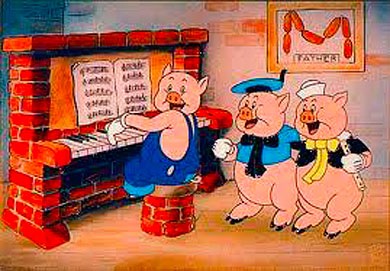
Disney’s
Three Little Pigs

The story utilizes the literary rule of three, expressed in this case as a “contrasting three”, as the three pigs’ brick house turns out to be the only one that is adequate to withstand the wolf.

Variations of the tale appeared in Uncle Remus: His Songs and Sayings in 1881. The story also made an appearance in Nights with Uncle Remus in 1883, both by Joel Chandler Harris, in which the pigs were replaced by Brer Rabbit. Andrew Lang included it in “The Green Fairy Book”, published in 1892, but did not cite his source. In contrast to Jacobs’ version, which left the pigs nameless, Lang’s retelling cast the pigs as Browny, Whitey, and Blacky. It also set itself apart by exploring each pig’s character and detailing

interaction between them. The antagonist of this version is a fox, not a wolf. Blacky, the third pig, rescues his brother and sister from the fox’s den after killing the fox.

Retellings of the story sometimes omit the attempts to trick the third pig, or state that the first pig ran to the second pig’s house, and then both of them ran to the third pig’s house of bricks. The latter is often an attempt to write out death or violence in the story and the first and second little pigs have their own brick houses.

A well-known version of the story is an award-winning 1933 Silly Symphony cartoon, produced by Walt Disney. The production cast the title characters as Fifer Pig, Fiddler Pig, and Practical Pig. The first two are depicted as both frivolous and arrogant. The end of the story has been slightly altered: the wolf is not cooked but instead burns his behind and runs away howling.